Blogging is still one of the most reliable ways to reach customers in 2026
A solid blog content marketing strategy is the difference between a blog that builds your business and one that produces no results.
Here is what an effective strategy includes.
- Map content to the full customer journey from awareness to purchase to retention
- Research keywords that match what your audience is actually searching for
- Build a repeatable monthly process for writing, editing, and publishing
- Repurpose blog content into social posts, emails, and other formats
- Track the right metrics and update older posts to keep rankings
- Avoid common mistakes like thin content, inconsistency, and ignoring SEO
Most small business owners start a blog the same way. They sit down, write something, hit publish, and wait.
Nothing happens. So they write another post. Still nothing.
Eventually the blog goes cold and the whole effort gets written off as a waste of time.
The problem is almost never the writing itself. It is the lack of a strategy behind it.
Without a clear plan, blogging turns into guesswork.
You create content without knowing who it is for, what they are searching for, or what you want them to do next. That is how good businesses end up with a blog full of posts that no one reads and no leads to show for it.
Blogging works when it is treated like an operating system, not a hobby. When each post is tied to a real customer question and a clear next step, your site starts doing the work while you run the business.
I am Connor Lagman, founder of Attention Digital. Over the past decade, I have helped local businesses, startups, and nonprofits build organic marketing systems, including blog content marketing strategies, that drive measurable growth without paid ads or long-term agency contracts.
Everything in this guide comes from what has actually worked for the businesses we have partnered with.
Glossary for blog content marketing strategy
Blogging is often labeled as a relic of the early internet, but it still holds up in 2026.
Search continues to dominate how people find answers. When someone has a problem, they usually do not look for an ad first. They look for a clear explanation they can trust.
That is exactly what a good blog provides. It gives your best answers a permanent home and makes them easy to find.
For B2B companies in Indianapolis and nearby areas like Carmel or Fishers, blogging is not a creative side project. It is a practical lead source when it is done consistently and tied to search intent.
Another advantage is durability. Ads stop the moment the budget pauses. A strong post can keep bringing in qualified traffic for months or years.
| Metric | Blogging (Organic) | Paid Advertising |
|---|---|---|
| Lead Volume | Often higher over time | Often higher upfront |
| Longevity | Compounding long-term asset | Stops with budget |
| Search Visibility | Improves with consistency | Only visible while paying |
| Trust Factor | High when educational | Lower when promotional |
If you want a channel you can own, improve, and rely on, a blog is still one of the clearest bets you can make.
Seven steps that turn your blog into a consistent lead source
Creating a blog content marketing strategy that delivers results means moving away from random posts and toward a simple, repeatable plan.
We focus on an organic-first approach because it builds long-term equity for your brand. This starts with understanding What is Organic-First Digital Marketing? and how it prioritizes the needs of the user over the demands of an algorithm.
Start by setting clear, measurable goals.
Are you trying to increase brand awareness in Zionsville, or do you need more demo requests for a service or software trial?
Once your goal is set, define your audience in practical terms. Go beyond demographics.
Focus on their day-to-day frustrations, the questions they ask before they buy, and the exact language they use when they describe the problem.
Cover the full funnel so you do not depend on ready to buy traffic
A common mistake is writing only for people who are ready to buy today.
In reality, most of your audience is still in the Awareness or Consideration stages. A complete blog content marketing strategy addresses every step of the content marketing funnel.
In the Awareness stage, your content should focus on broad educational topics.
For example, a local accounting firm in Noblesville might write about common tax mistakes for new small business owners. They are not selling their services yet. They are building trust and getting the right visitors on the site.
As the reader moves into the Consideration and Selection stages, the content becomes more specific.
This is where you use bottom-of-the-funnel keywords to help users compare options and make a decision.
Use keyword research to match real questions with clear answers
Keyword research connects your expertise to what your customers are already searching for.
Instead of guessing what people want to read, you can use data to find the phrases they type into Google.
High-volume head terms are tempting, but the best opportunities for small businesses are usually long-tail keywords.
Long-tail phrases are more specific and often show stronger intent.
For instance, digital marketing is too broad. How to build a content marketing strategy for a nonprofit points to a real situation and a real need.
You can find these opportunities by reviewing 10 Clever SEO Keyword Research Examples and looking for gaps your competitors have not covered well.
Do not stop at search volume. Check search intent.
Does the user want to learn (Informational), find a specific site (Navigational), or take action (Transactional)? Your blog posts should satisfy informational and transactional intent most of the time.
A simple monthly workflow keeps quality high without burning out your team
Consistency matters, but it is also the hardest part to maintain.
Most teams struggle because there is no defined process. To avoid burnout, build a content calendar that maps production at least a month ahead.
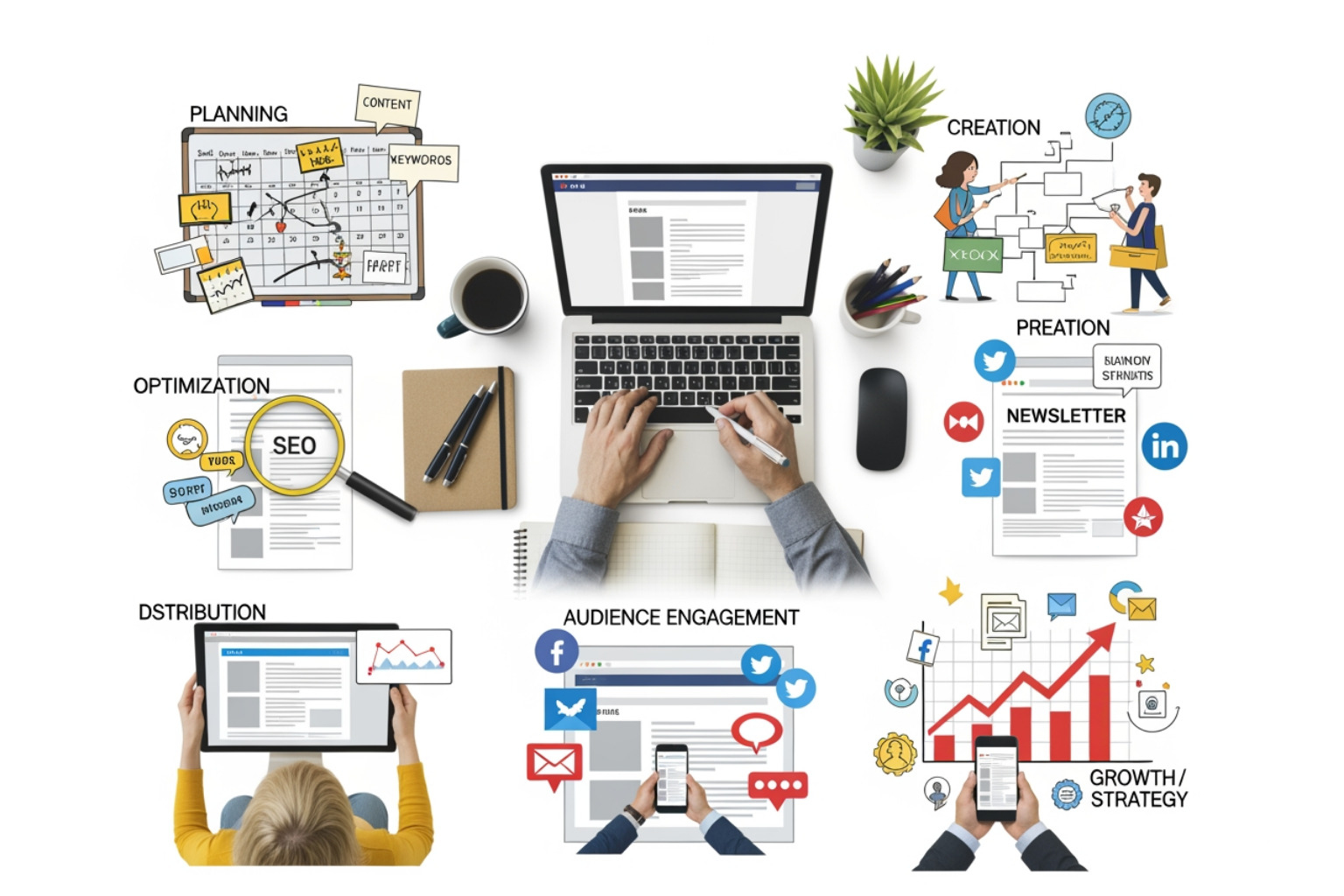
A sustainable workflow usually includes four phases.
- Briefing. Define the goal, target keyword, and outline.
- Drafting. Write with a focus on clarity and usefulness.
- Review. Check for SEO and readability so the post works for humans and search engines.
- Distribution. Schedule the post and prepare promotional assets.
This is a core part of How to Create a Marketing Strategy for Your Small Business.
When you have a repeatable system, you spend less time wondering what to write and more time improving what you publish.

Turn one strong post into a week of social and email content
One blog post should never be just one blog post.
If you spend four hours writing a high-quality article, plan to spend real time making sure the right people see it.
Think of your blog as the source file for the rest of your marketing.
For every blog post you publish, you can create.
- A series of social media updates that highlight different takeaways.
- A summary for your email newsletter that drives traffic back to the full post.
- A short video script or an infographic using tools like Adobe Express.
This approach is often called the Hub and Spoke model.
It helps your message reach people where they already spend time, and it reinforces that you are consistent and credible.
Regular updates keep your best posts ranking and converting
A blog content marketing strategy is not set-and-forget.
The digital landscape changes, and your content needs to change with it.
We use StoryChief’s analytics to track which posts drive business results versus vanity traffic.
One of the most effective tactics for long-term growth is a content audit.
Over time, even strong posts can lose rankings as competitors publish fresher information.
By regularly performing a Content Audit, you can find posts that are slipping and refresh them.
Adding a few hundred words of new insight, updating outdated details, and improving the headline can often lift performance and bring a post back to page one.
Key metrics worth tracking include.
- Organic Traffic. Are people finding you through search?
- Dwell Time. Are they actually reading the content?
- Conversion Rate. Are they taking a next step such as signing up for a newsletter?
Fix these common blogging mistakes before they waste another quarter
Even with good intentions, a few common mistakes can stall progress.
One of the biggest is thin content. Posts that are too short, too generic, or too similar to what everyone else is saying rarely rank and rarely convert.
Another pitfall is inconsistency.
Posting five times in one week and then disappearing for two months signals to readers and search engines that your site is not a reliable source.
It is better to post once every two weeks consistently than to publish in bursts.
Finally, many businesses ignore the technical side of What is SEO & Who is it a Good Fit For?.
If your blog is not optimized for mobile or it loads slowly, people leave before they read the first paragraph.
Ensuring your Website Design supports a clean, fast reading experience helps keep bounce rates down.
Watch for these issues.
- Ignoring search intent. Writing what you want to say instead of what customers are trying to solve.
- No clear call to action. Leaving the reader with no next step.
- Focusing on quantity over quality. More is not better when the content is weak.
- Forgetting internal links. Not connecting new posts to your existing content pillars.
Common questions about blog content marketing
How often should a small business post new content
There is no magic number, but for most small businesses in Indianapolis, one high-quality post per week is a great goal. If your resources are limited, twice a month is the bare minimum to maintain momentum. The key is to choose a frequency you can actually stick to for the long-term. Quality and consistency will always beat high-volume, low-quality output.
What is the difference between a blog post and a content strategy
A blog post is a single piece of content. A blog content marketing strategy is the overarching plan that dictates why that post was written, who it was written for, how it will be promoted, and how its success will be measured. The strategy is the plan that ensures every post serves a specific business purpose.
How do you measure the return on investment for blogging
We measure ROI by looking at Customer Acquisition Cost (CAC). Since blogging is an organic strategy, the cost is primarily the time or labor spent creating it. Over time, as your organic traffic grows, your CAC should decrease because you are attracting leads without paying for every click. We also track assisted conversions-cases where a user read a blog post weeks before they finally decided to make a purchase.
When your blog runs on a system your website starts working for you
Blogging takes patience.
It takes time to build authority and earn trust, but the payoff compounds.
When you stop publishing into the void and start following a structured blog content marketing strategy, your website becomes a business asset that keeps producing.
At Attention Digital, we help small businesses, startups, and nonprofits in the Indianapolis area, from Carmel to Zionsville, build that kind of organic growth.
We keep the process clear, we handle the technical details, and we focus on what moves the business forward.
If you want to get serious about consistent traffic and qualified leads, start by defining your content pillars and building a production rhythm you can maintain.
Ready to take the next step? Explore our services or reach out to start a conversation.